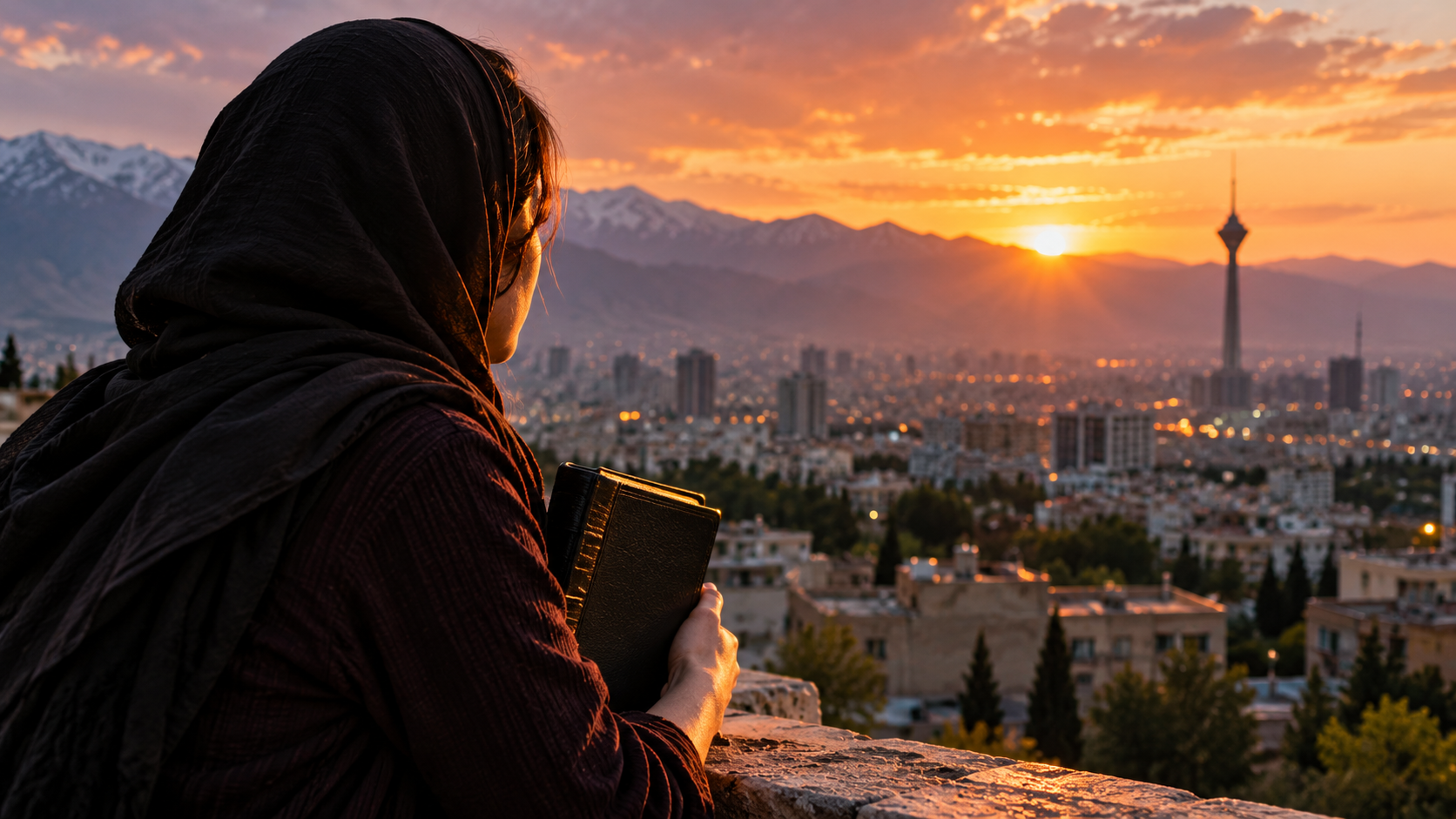
Can you be a Christian in Iran? The answer is yes—but the reality is far more complicated than a simple yes or no.
Christianity has existed in Iran for nearly two thousand years. Today, Christian communities continue to worship, preserve their traditions, and practice their faith. Yet the freedom to identify as Christian does not necessarily mean the freedom to convert to Christianity, share the Gospel, establish a church, or worship without government interference.
For many Iranian Christians, particularly those who have converted from Islam, practicing their faith can involve secrecy, surveillance, discrimination, arrest, and imprisonment.
To understand Christianity in Iran, we must first recognize an important distinction: the difference between Christians who belong to historically recognized religious communities and Iranians who become Christians after being raised Muslim.
Is Christianity Legal in Iran?
Iran’s constitution recognizes Christianity as one of the country’s official religious minorities, alongside Judaism and Zoroastrianism.
Article 13 of the Iranian Constitution provides limited recognition for these religious communities, including certain rights to conduct religious ceremonies and manage personal affairs according to their traditions.
However, constitutional recognition does not guarantee equal religious freedom.
Historically established Armenian and Assyrian Christian communities are generally permitted to operate recognized churches, although they face restrictions and government oversight.
For Iranians who convert from Islam to Christianity, the situation can be very different.
Iranian authorities have treated Christian conversion, evangelism, and participation in independent house churches as potential threats to national security.
As a result, some Christians have faced interrogation, detention, prosecution, and imprisonment because of activities connected to their religious beliefs.
In practice, the central question is not simply whether Christianity exists legally in Iran. It is whether every Iranian has the freedom to choose Christianity and practice it openly.
For many converts, that freedom remains severely restricted.
Can a Muslim Convert to Christianity in Iran?
Conversion from Islam to Christianity is one of the most sensitive religious issues in Iran.
Iranian law and its application create serious risks for some Muslim-background converts.
Although Iran’s constitution recognizes certain Christian communities, it does not provide equivalent protection for Muslims who choose to become Christians.
Converts may face pressure from authorities, restrictions on worship, and criminal prosecution connected to their religious activities.
Some have been accused of acting against national security, participating in unauthorized religious gatherings, or engaging in activities that authorities interpret as political or ideological threats.
The risks are not identical for every convert. They depend on factors including visibility, religious activities, local circumstances, and government attention.
Nevertheless, the consequences can be significant.
For someone living in a country where religion is closely connected to political authority, choosing a different faith can become much more than a private spiritual decision.
It can affect family relationships, education, employment, personal security, and freedom.
What Are Underground House Churches in Iran?
An underground house church is generally a small Christian community that gathers privately rather than worshiping in a publicly recognized church building.
In Iran, these gatherings often involve Christians who have converted from Islam or who cannot safely participate in conventional church structures.
Rather than meeting in large sanctuaries, believers may gather in private homes or other discreet locations.
Their activities can include Bible study, prayer, worship, Christian teaching, and discipleship.
House churches are not necessarily underground because Christians prefer secrecy.
For many believers, secrecy is a response to restrictions that make open religious gatherings dangerous.
The underground church movement reflects a fundamental desire: to practice Christianity in community despite the risks.
For Christians living in countries where religious gatherings are freely permitted, attending church may be a routine part of life.
For some Iranian converts, participating in a Christian gathering requires careful consideration of personal and family safety.
The difference is profound.
Why Does the Iranian Government Restrict House Churches?
Iranian authorities have often viewed independent Christian networks, particularly those involving Muslim-background converts and evangelism, through a national-security lens.
Officials have alleged that certain religious activities are connected to foreign influence, unauthorized organizations, or threats to the Islamic Republic.
Human rights organizations and religious freedom advocates, however, have documented cases in which peaceful religious practices have resulted in serious criminal charges.
This creates a fundamental disagreement over the nature of these activities.
From the government’s perspective, some independent religious networks are treated as security concerns.
From the perspective of Christians and religious freedom advocates, gathering to pray, study the Bible, and practice one’s faith should not constitute a criminal offense.
International human rights standards recognize freedom of religion or belief, including the freedom to change one’s religion and to practice it individually or in community with others.
Iran’s restrictions on conversion and independent Christian worship raise serious concerns under those standards.
What Happens When Iranian Christians Are Arrested?
The experiences of detained Christians vary considerably.
Some are questioned and released. Others face prolonged detention, criminal charges, or prison sentences.
Human rights reporting has documented allegations of pressure during interrogation, restrictions on access to legal representation, and prosecutions related to peaceful religious activity.
For affected families, an arrest can have consequences extending far beyond the detained individual.
Children may lose daily contact with a parent.
Spouses may face financial uncertainty.
Relatives may fear additional scrutiny.
Even after release, individuals can experience ongoing pressure, restrictions, or concerns about their future.
The impact of religious persecution cannot be measured only by the number of arrests or prison sentences.
It must also be understood through the disruption of ordinary family life.
Can Christians Own and Read a Bible in Iran?
The answer depends partly on the context.
Christian religious texts are used within Iran’s historically recognized Christian communities. However, the production, distribution, and possession of Persian-language Christian materials associated with evangelism or conversion can attract government scrutiny.
Farsi-language Christian literature is particularly significant because Farsi is the primary language of much of Iran’s population.
For Muslim-background converts, access to the Bible in their own language can be an important part of learning about Christianity.
Yet distributing Christian literature to others, especially in connection with evangelism, can create legal and personal risks.
It is important not to confuse these restrictions with a universal prohibition on every Bible or every act of Bible reading.
The situation is more complex.
The central concern is the unequal treatment of religious expression and the risks faced by people whose Christian activities fall outside state-approved religious structures.
Why Do Some Iranians Become Christians?
Religious conversion is deeply personal, and no single explanation describes everyone who chooses Christianity.
Some individuals become interested in Christianity through reading the Bible.
Others encounter Christian teachings through personal relationships, online resources, or conversations about faith.
Some describe a gradual process of questioning, reflection, and spiritual exploration.
Others report profound personal experiences that lead them toward Christianity.
It would be inaccurate to suggest that all Iranian converts share the same motivations.
What connects many of their experiences, however, is the significance of making a religious choice in an environment where that decision may carry substantial consequences.
For some, Christianity becomes not only a religious identity but also a source of hope, belonging, and spiritual purpose.
The Growth of Underground Christianity in Iran
Despite restrictions, independent Christian communities have continued to exist in Iran.
Reports from religious freedom organizations, researchers, and Christian networks describe ongoing conversion, discipleship, and participation in house churches.
However, determining the exact number of Christian converts or underground church members is extremely difficult.
There is no comprehensive public registry of underground believers.
Many individuals do not disclose their religious identity because of safety concerns.
Different organizations also use different methods to estimate Christian populations.
Consequently, published estimates vary, and claims about the total size of Iran’s underground church movement should be evaluated carefully.
What can be said with greater confidence is that Muslim-background Christian communities remain an important part of Iran’s contemporary religious landscape.
Their existence challenges the assumption that religious identity in Iran is entirely uniform.
Iranian Underground House Churches (IUHC): Faith Beyond Church Buildings
The Iranian Underground House Churches (IUHC) describes its mission as supporting Christian discipleship, Bible education, leadership development, and house church communities across Iran.
According to IUHC’s organizational reporting, its activities include helping believers study Scripture, develop Christian leadership, and remain connected with other Christians.
The organization also reports involvement in Bible distribution, baptisms, and religious education.
Because underground religious networks operate in sensitive environments, publicly verifying every organizational statistic or activity can be difficult.
Protecting the identities of participants is especially important.
Names, photographs, and precise locations should never be disclosed in ways that could expose believers or their families to danger.
The experiences of underground Christians illustrate an important reality: a church is not defined only by a building.
For believers who cannot gather openly, religious community may continue through small gatherings, personal relationships, teaching, prayer, and mutual support.
What Does Baptism Mean for Iranian Christians?
Baptism is one of Christianity’s most significant religious practices.
For Christians, it represents identification with Jesus Christ and a public expression of faith.
In many countries, baptism takes place openly in church buildings, rivers, or other gathering places.
For some Iranian converts, baptism may carry additional personal and social risks because it can make their religious identity more visible.
Nevertheless, many believers regard baptism as an important part of their Christian journey.
The meaning of baptism does not change because the circumstances are difficult.
It remains an expression of faith, commitment, and spiritual identity.
Learn more about the baptism ministry and reported baptisms of Iranian Underground House Churches:
Water Baptism — Becoming Joshua
Is Christianity Growing in Iran Despite Persecution?
There is evidence that Christian conversion and independent Christian networks continue to exist despite restrictions.
However, claims about the precise rate of growth require caution.
Underground communities are inherently difficult to study, and estimates may differ significantly.
What is clear is that government restrictions have not eliminated Christian belief or religious conversion in Iran.
Christians continue to seek religious education, community, and opportunities to practice their faith.
For some believers, their commitment persists despite the possibility of serious personal consequences.
That persistence is an important part of the story of Christianity in modern Iran.
Why Should the World Care About Religious Freedom in Iran?
Religious freedom is not simply the right to belong to a government-recognized religious community.
It includes the freedom to hold beliefs, change beliefs, express beliefs, and practice religion peacefully.
This principle applies to everyone.
A Muslim should have the freedom to practice Islam.
A Christian should have the freedom to practice Christianity.
A person who changes religions should not face imprisonment because of that decision.
And someone who chooses not to follow any religion should also be protected.
The situation facing Christian converts in Iran raises broader questions about individual conscience, government authority, and fundamental human rights.
These questions extend beyond religious differences.
They concern whether people should be allowed to make deeply personal decisions about faith without fear of punishment.
The Church Without Walls
For many people, the word church brings to mind a building, a sanctuary, or a congregation gathering publicly on Sunday morning.
But Christianity in Iran reveals another picture.
A church may exist without a sign outside its door.
It may have no permanent building, no public schedule, and no recognizable address.
Its members may not be able to announce their faith openly.
Yet they continue to study, pray, worship, and support one another.
The underground church movement reminds us that religious identity does not disappear simply because its public expression is restricted.
The question is not whether Christians exist in Iran. They do.
The deeper question is whether they can practice their faith with the same freedom and dignity that every person deserves.
Until that freedom is fully protected, the experiences of Iranian Christians will remain an important part of the global conversation about human rights and religious liberty.
Frequently Asked Questions About Christianity in Iran
1. Can you legally be a Christian in Iran?
Iran recognizes certain historically established Christian communities. However, Muslim-background converts and members of independent house churches can face significant restrictions and legal risks.
2. Are there Christian churches in Iran?
Yes. Iran has historically established Armenian and Assyrian Christian churches, as well as independent Christian communities that may gather privately.
3. Is converting from Islam to Christianity allowed in Iran?
Converts from Islam do not enjoy the same protections as members of recognized historic Christian communities. Conversion and related religious activities can lead to serious legal and personal consequences.
4. What is an underground church in Iran?
An underground church is a Christian community that gathers privately, often because its members cannot safely worship through publicly recognized religious institutions.
5. Can Iranians read the Bible?
Bibles are used within recognized Christian communities, but Persian-language Christian materials connected to conversion or evangelism can attract government scrutiny.
6. Are Christians persecuted in Iran?
Human rights organizations have documented arrests, prosecutions, and restrictions affecting Christians, particularly converts and people involved in independent house churches.
7. How many Christians live in Iran?
Estimates vary. The underground nature of many Christian communities makes accurate population counts difficult.
8. Why do Christians gather secretly in Iran?
Some gather privately because open participation in independent Christian activities can expose them to government surveillance, interrogation, or prosecution.
Continue Exploring
Iranian Underground House Churches (IUHC)
Learn about the experiences, challenges, and faith of Iranian Christians.
IUHC Magazine
Read articles, testimonies, and reporting about Christianity and underground house churches in Iran.
Water Baptism
Explore information about Christian baptism and the ministry’s reported baptism activities.
Editorial note: This article provides general information about religious freedom and Christianity in Iran. Legal conditions and enforcement practices can change. IUHC organizational activities are described on the basis of the organization’s own reporting.