
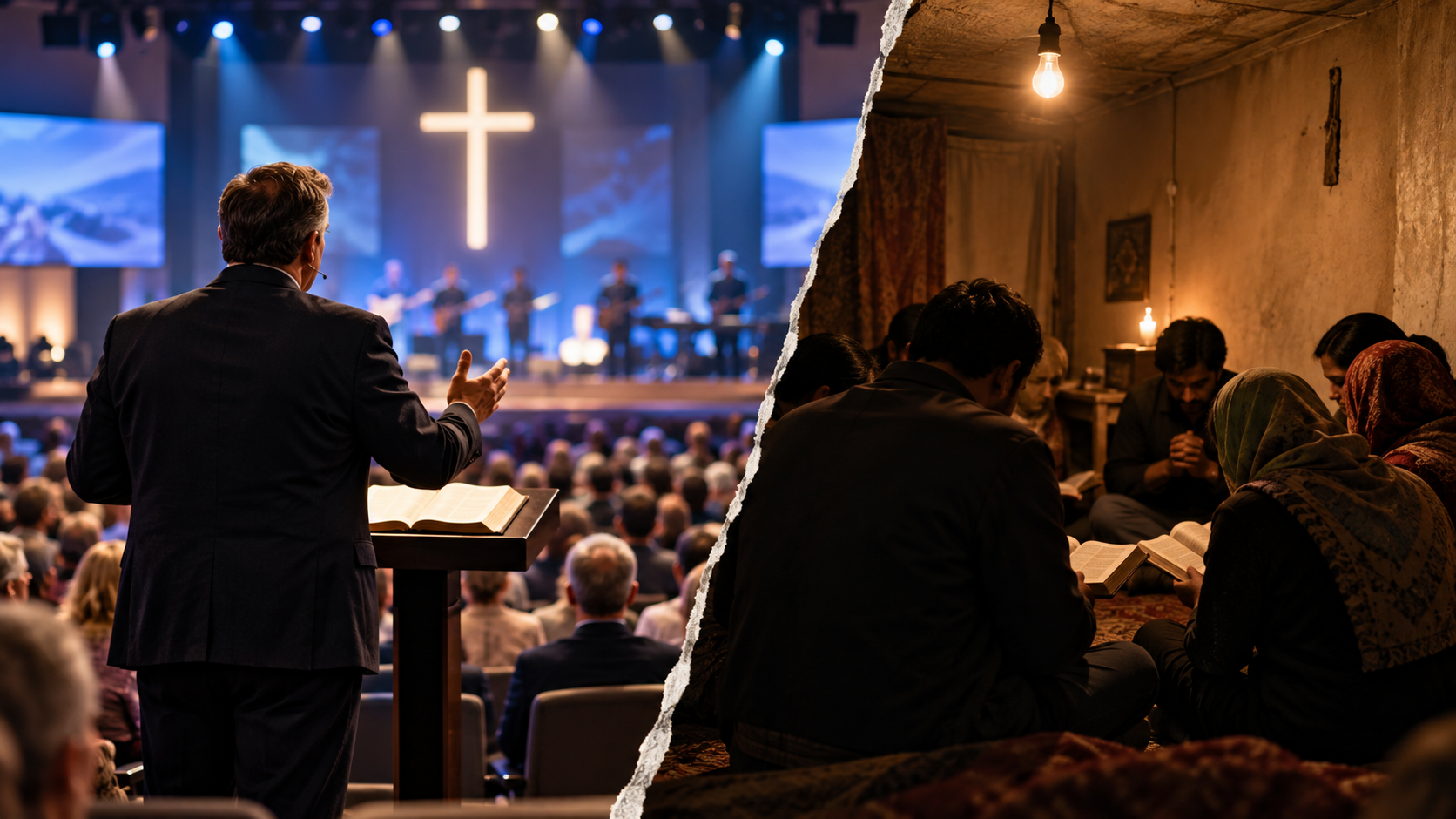
When Christianity becomes comfortable, the suffering church can become invisible.
Every Sunday, millions of Christians across the United States gather in beautiful church buildings. Worship teams rehearse, microphones are tested, coffee is served, and pastors prepare sermons about faith, courage, sacrifice, and the lives of the apostles.
Some preach about Paul.
They speak passionately about his imprisonment, his suffering, his courage, and his willingness to sacrifice everything for Jesus Christ.
They quote his letters. They admire his endurance. They encourage their congregations to follow his example.
And then Sunday ends.
The lights go off. The congregation goes home. The pastor begins preparing another sermon.
Meanwhile, somewhere in Iran, a Christian may be sitting in a prison cell because of the same Gospel Paul preached.
A mother may be separated from her children because of her faith. A young believer may be questioned about attending a house church. A Christian leader may face the possibility of losing employment, freedom, family relationships, or even life because of a decision to follow Jesus.
And much of the American church remains silent.
How did we become so comfortable preaching about persecuted Christians of the past while paying so little attention to persecuted Christians of the present?
1. We Have Turned Paul’s Suffering Into a Sermon Illustration
The Apostle Paul was not a religious celebrity living a comfortable life.
He was beaten, imprisoned, threatened, rejected, and repeatedly placed in danger because of his ministry.
In 2 Corinthians 11:23–27, Paul describes imprisonments, beatings, dangerous journeys, hunger, exposure, and sleepless nights.
These were not metaphors. They were experiences.
When Paul wrote about suffering for Christ, he was not preparing inspirational material for a conference. He was describing the cost of his calling.
Yet today, Paul’s persecution can become a familiar preaching subject that demands little of the people listening.
We admire his courage without asking whether we are willing to share his burdens.
We celebrate his letters from prison without remembering that Christians are still writing prayers from prison cells.
We study his chains as history while overlooking the chains of believers living in our own generation.
Paul’s suffering was never intended to become entertainment for comfortable Christianity. It was a testimony of faithfulness and an invitation to solidarity.
The question is not whether American pastors know Paul’s story.
The question is whether they recognize that the story of Christian persecution did not end with Paul.
2. Jesus Never Promised His Followers a Comfortable Christianity
In John 15:20, Jesus reminds his disciples that persecution is something they may experience because of their relationship with him.
In Matthew 16:24, he calls those who would follow him to deny themselves and take up their cross.
And in Matthew 25:36, Jesus identifies visiting those in prison as an expression of compassion toward people in need.
The New Testament does not present Christian discipleship as a guarantee of wealth, popularity, safety, or social acceptance.
It presents a life of faith, love, service, sacrifice, and obedience.
There is nothing wrong with a church having a building, financial resources, trained staff, or modern technology. These things can serve important purposes.
The problem begins when comfort becomes more important than compassion.
When maintaining an institution becomes more urgent than helping suffering believers.
When a church can raise millions for expansion but cannot find the time to pray publicly for imprisoned Christians.
When pastors speak passionately about the cost of discipleship but rarely acknowledge those who are paying that cost today.
A comfortable church is not necessarily an unfaithful church. But a church that has become indifferent to suffering must examine its understanding of the Gospel.
3. We Remember the Ancient Church but Forget the Underground Church
Many American Christians admire the early church.
They speak about believers gathering in homes, sharing possessions, praying together, and enduring opposition.
Acts 2:42–47 is frequently cited as an example of Christian fellowship.
Yet similar expressions of Christian community exist today among believers who cannot freely establish public congregations.
In Iran, some Christian converts gather privately in homes because of restrictions and the risks associated with their religious activities.
They may worship without a stage, a professional sound system, a paid worship team, or a publicly advertised service.
They may have no church sign and no building bearing their congregation’s name.
Their gatherings may be small.
Their resources may be limited.
Their security concerns may be significant.
But they are still churches.
A church is not made legitimate by the size of its auditorium, the popularity of its pastor, or the sophistication of its technology.
The New Testament repeatedly describes Christian communities in terms of people, fellowship, prayer, teaching, service, and love.
If we admire the house churches of the first century but overlook the house churches of the twenty-first century, we have misunderstood what we claim to admire.
4. We Speak About the Body of Christ but Act as Though Some Members Do Not Exist
In 1 Corinthians 12:26, Paul writes:
“If one member suffers, all suffer together.”
This is one of the most challenging statements in the New Testament.
Paul does not say that Christians should care only when suffering happens in their country, denomination, or congregation.
He describes the church as one body.
If a Christian is imprisoned for religious activity in Iran, that suffering should matter to Christians in Michigan.
If a believer is threatened because of conversion, that experience should concern Christians in Texas.
If a Christian family faces persecution, their situation should matter to churches in California, Florida, and every other state.
The church is not supposed to be united only by theology, conferences, music, or shared religious language.
It is also supposed to be united by love expressed through action.
Hebrews 13:3 tells believers to remember prisoners as though imprisoned with them and those who are mistreated as though suffering alongside them.
Imagine what American Christianity would look like if every pastor took that instruction seriously.
What if every church regularly prayed for imprisoned Christians?
What if congregations learned the realities facing religious minorities and converts in restrictive countries?
What if Christian leaders used their influence to defend religious freedom instead of focusing exclusively on institutional success?
What if supporting persecuted believers became part of ordinary church life rather than an occasional special offering?
The New Testament does not allow us to separate love for Christ from concern for his people.
5. When Church Becomes a Business, Suffering Becomes an Inconvenience
American churches operate in a society where religious organizations can build institutions, employ professional staff, raise funds, purchase property, and communicate publicly.
These freedoms are valuable.
They should not be taken for granted.
But freedom also creates responsibility.
Churches can become so occupied with attendance figures, fundraising goals, building projects, branding, social media, and organizational expansion that the suffering of Christians elsewhere receives little attention.
A pastor may have a sophisticated communications team but no established way to respond when believers are imprisoned for their faith.
A church may spend considerable resources promoting a conference while offering little education about contemporary religious persecution.
A congregation may celebrate its growth while rarely discussing the needs of vulnerable Christian communities.
This is not an argument that church buildings, staff salaries, or professional ministry are inherently wrong.
It is a question of priorities.
Jesus warned against serving both God and money in Matthew 6:24.
Peter instructed church leaders to shepherd God’s people willingly and not for dishonest gain or personal domination (1 Peter 5:2–3).
Church leadership is a responsibility, not a platform for personal importance.
The church should never become so successful at promoting itself that it forgets the people Jesus called it to serve.
6. The Persecuted Church Does Not Need Our Applause. It Needs Our Solidarity.
Sometimes persecuted Christians are invited into American church conversations only when their stories are dramatic enough to attract attention.
A testimony of imprisonment may become a powerful conference moment.
A story of conversion may be used in a fundraising campaign.
A photograph of an underground gathering may generate excitement on social media.
But what happens afterward?
Do those Christians remain part of the church’s concern when the conference ends?
Are their needs considered when the budget is prepared?
Are their families remembered when there is no compelling photograph or dramatic testimony to share?
Solidarity requires more than admiration.
It requires consistent concern, responsible relationships, and practical action.
It also requires protecting the dignity and safety of persecuted believers.
Their identities, experiences, and suffering should never be exploited for publicity or financial gain.
Their stories are not marketing material.
They are human lives.
7. Not Every American Church Has Forgotten
It would be unfair to claim that every American church ignores persecuted Christians.
Many churches, pastors, ministries, and individual believers have spent decades praying, advocating, providing humanitarian assistance, and supporting religious freedom.
Some have quietly helped vulnerable families without seeking public recognition.
Others have educated their congregations, supported refugees, and stood beside believers who faced imprisonment or discrimination.
Their efforts deserve respect.
But the existence of faithful examples does not remove the need for broader reflection.
The question remains whether concern for the persecuted church is central to American Christian life or confined to a relatively small number of committed congregations and organizations.
We should not measure our faithfulness by comparing ourselves with churches that do less. We should measure it against the responsibilities Scripture places before us.
8. What Would Paul Say to American Pastors Today?
Imagine Paul walking into a modern American church.
He sees the building, the stage, the screens, the professional music, and the resources available to communicate the Gospel.
Perhaps he would be grateful for the opportunities those resources create.
But what would he ask about the believers who are suffering?
Would he ask how many followers a pastor has on social media?
Or would he ask whether the congregation remembers those in prison?
Would he ask how impressive the building looks?
Or whether its doors are open to the vulnerable?
Would he celebrate a ministry’s popularity?
Or examine whether its people are growing in love, generosity, humility, and faithfulness?
We cannot claim to know exactly what Paul would say to a contemporary congregation.
But we can read what he already wrote.
In Galatians 6:2, he instructs believers to carry one another’s burdens.
In Romans 12:15, he calls Christians to weep with those who weep.
And in 1 Corinthians 12:26, he reminds the church that the suffering of one member concerns the entire body.
Paul’s message was not merely about enduring suffering personally.
It was also about the responsibility Christians have toward one another.
9. A Message From Someone Who Has Known Persecution
I was born in Iran.
I know what it means to live in a country where religious identity can have serious consequences.
I know what it means to face imprisonment because of faith.
I also know what it means to arrive in the United States and experience freedoms that millions of people around the world do not enjoy.
I am grateful for those freedoms.
I am grateful that churches in America can gather openly, publish Christian literature, speak publicly about their beliefs, and worship without the same restrictions faced by many converts in Iran.
But gratitude for freedom should not become indifference toward those who do not have it.
Through my work with Iranian Underground House Churches, I have come to believe that one of the greatest challenges facing comfortable Christianity is not necessarily a lack of knowledge.
It is the distance between what we know and what we are willing to do.
We know that Christians are persecuted.
We know that believers face imprisonment.
We know that families can suffer because of religious restrictions.
And yet these realities can remain distant from our daily priorities.
I am not asking American Christians to feel guilty for being free.
I am asking them to use their freedom to remember those who are not.
10. What American Churches Can Do Today
The response does not have to begin with a large financial commitment or an international program.
It can begin with a change in priorities.
Pastors can teach about contemporary persecution alongside biblical accounts of suffering.
Churches can establish regular prayer for imprisoned believers and vulnerable religious communities.
Congregations can learn from reliable religious-freedom reporting and support organizations with responsible safeguarding practices.
Church leaders can advocate peacefully for freedom of religion or belief, including the right to change one’s religion.
Christian communities can offer practical support to refugees and families affected by persecution.
And when underground believers share their experiences, American churches can listen without turning their suffering into a spectacle.
The purpose is not to glorify persecution.
Suffering is not proof that one Christian is more faithful than another.
The purpose is to refuse indifference.
Freedom gives American churches opportunities that many Christians elsewhere do not possess.
Those opportunities can become instruments of compassion.
Conclusion: Stop Only Preaching About Paul. Remember Those Living His Story.
It is easy to admire a Christian who suffered two thousand years ago.
His story is complete.
His words are preserved in Scripture.
His courage can be celebrated without requiring us to confront a present crisis.
It is more difficult to respond to a Christian suffering today.
That person may need advocacy, compassion, practical assistance, and years of patient support.
Their situation may be complicated.
Their story may not have a happy ending.
Their suffering may require something more than applause.
But this is precisely where the church’s responsibility becomes real.
American pastors should continue preaching about Paul.
They should teach his letters, explain his theology, and honor his example.
But they must not forget that while they preach about Paul’s chains, other Christians are still facing prison because of their faith.
The Gospel that sustained Paul is still meaningful to believers in Iran and elsewhere who worship under restrictions.
The church that remembers Paul’s suffering should also remember theirs.
Because Christianity was never meant to be a comfortable institution that admires sacrifice from a distance.
It was meant to be a community of people who love one another, carry one another’s burdens, and refuse to abandon those who suffer.
Do not merely preach about Paul.
Remember the Christians living with the cost of faith today.
And if we truly believe that the church is one body, then their suffering cannot remain someone else’s problem.
Joshua Ehm is an Iranian-born American author, educator, former refugee, and founder of Iranian Underground House Churches (IUHC). His writing explores faith, persecution, religious freedom, leadership, and the experiences of people rebuilding their lives after displacement.
Editorial note: This article is a personal theological and ethical commentary. References to persecution describe documented patterns and illustrative circumstances rather than identifying specific individuals or undisclosed cases.