
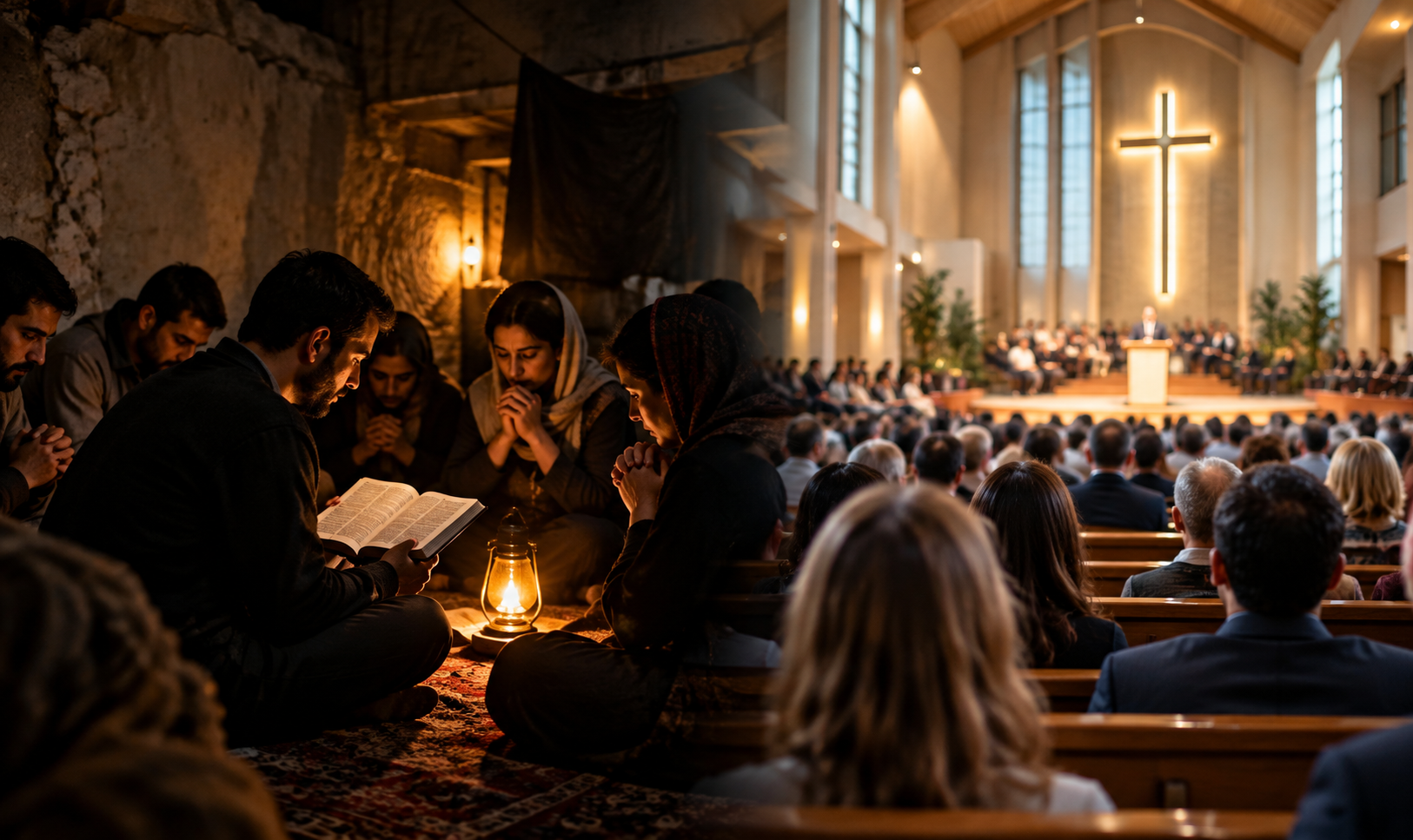
When Faith Costs Everything, the Meaning of Church Changes
What if some of the strongest churches in the world are the ones without buildings, budgets, paid pastors, or the freedom to gather publicly?
In the United States, churches often measure success through attendance, financial giving, buildings, programs, staff, and the number of people participating in Sunday services.
But what happens when a church has none of these things?
What happens when gathering for worship can lead to interrogation, imprisonment, the loss of employment, or separation from family?
For underground Christians in Iran, these are not merely theological questions. They are realities that shape everyday life.
And yet, underground Christian communities continue to worship, teach, disciple, and share their faith.
This raises a challenging question for Christians in America:
Could a church with fewer resources accomplish more of its spiritual mission than a church with every available resource?
The answer depends on what we mean by success.
1. American Churches Have Resources. Underground Churches Have Urgency.
Many American churches enjoy extraordinary opportunities.
They can purchase property, establish educational institutions, broadcast sermons, publish books, organize conferences, employ pastors, and publicly invite people to worship.
These freedoms are valuable. They allow churches to serve communities in ways that would be impossible under persecution.
But resources can also create a temptation: measuring a church’s health by what it owns rather than what it accomplishes in people’s lives.
A church can have a beautiful building and still struggle to develop committed disciples.
It can have thousands of attendees while some members remain disconnected from meaningful relationships, spiritual responsibility, or service.
Underground churches operate under different circumstances.
When believers gather secretly, they understand that their time together may be limited. Bible study, prayer, mutual encouragement, and discipleship are not simply scheduled activities. They are central to the community’s survival.
There is often less room for unnecessary competition over buildings, recognition, or institutional status.
The urgency of faith can become more important than the appearance of success.
2. Underground Churches Often Measure Commitment Differently
In America, attending church may require little more than getting into a car on Sunday morning.
For an underground Christian in Iran, participation may carry serious personal consequences.
Iranian Christian converts can face restrictions, surveillance, interrogation, and imprisonment connected to their religious activities.
That reality changes the meaning of commitment.
When someone chooses to follow Christianity despite the possibility of losing relationships, employment, or freedom, religious identity can become deeply connected to personal conviction.
This does not mean every persecuted believer is spiritually stronger than every American Christian.
It means the environment places different demands on discipleship.
For some underground believers, Christianity cannot remain merely a cultural identity or a Sunday tradition.
It becomes a decision that shapes everyday life.
3. Underground Churches Are Built Around Relationships, Not Buildings
A building can provide an excellent place for worship, education, counseling, and community service.
But a building is not what makes a church.
The early Christian movement spread through homes, personal relationships, teaching, shared meals, and mutual support.
Many underground churches operate through similar patterns.
People learn together. They pray together. They support one another during hardship. Leaders emerge through service and responsibility rather than through titles alone.
When the church is understood primarily as a community of believers, its identity does not depend on owning property.
This creates an important advantage: the community can continue practicing its faith even when it lacks institutional resources.
However, underground structures also face difficulties. Small groups may lack trained teachers, safeguarding procedures, financial stability, or access to reliable educational materials.
The lesson for American churches is not to abandon buildings.
It is to remember that buildings should serve relationships, rather than relationships existing merely to sustain buildings.
4. Underground Churches Can Develop Leaders Through Responsibility
In some established churches, leadership is closely associated with professional positions.
Pastors preach. Staff members organize programs. Volunteers help implement activities.
These arrangements can be effective, particularly when churches serve large populations.
But an underground community often cannot depend on a large professional staff.
Ordinary believers may need to take responsibility for teaching, mentoring, hospitality, pastoral care, and supporting others.
Leadership becomes something practiced rather than simply assigned.
A believer does not necessarily need a title to become an important source of encouragement and guidance.
This model can encourage active participation.
Instead of asking only, “What can my church provide for me?” members may ask, “What responsibility can I carry for others?”
That change in attitude can transform a congregation.
A spiritually healthy church is not simply a gathering of people who listen.
It is a community of people who participate.
5. Persecution Can Clarify Priorities—but It Is Not a Blessing to Romanticize
There is a dangerous misunderstanding that must be avoided.
Persecution is not automatically good for Christianity.
Imprisonment, torture, discrimination, and family separation cause real suffering. They can destroy communities, traumatize individuals, and make religious life extremely difficult.
No Christian should have to suffer persecution to demonstrate sincere faith.
Nevertheless, believers living under pressure sometimes develop a powerful understanding of what matters most.
When public recognition is unavailable, service may become more important than applause.
When financial resources are limited, relationships may become more valuable than organizational expansion.
When worship carries personal risk, participation may become a more deliberate choice.
These are lessons that churches in free societies can consider without wishing for persecution or minimizing its consequences.
The goal is not for American churches to experience the suffering of underground churches. The goal is for American churches to learn from their commitment without having to endure their circumstances.
6. American Christianity Faces a Different Challenge
Research provides important context.
Pew Research Center’s 2023–2024 Religious Landscape Study found that approximately 62% of American adults identified as Christian, compared with 78% in 2007.
The research also found that the longer-term decline in Christian identification had slowed or possibly stabilized in recent years.
These findings do not prove that American churches are failing spiritually. Nor do they establish that underground churches are growing faster or producing better disciples.
But they demonstrate that American Christianity is experiencing significant changes.
For churches accustomed to operating openly and with considerable institutional resources, these changes invite reflection.
Are churches investing enough in personal discipleship?
Are young people being prepared to take responsibility?
Are congregations building genuine relationships beyond Sunday services?
Are churches helping people practice their faith in their workplaces, families, and communities?
And perhaps most importantly:
Are churches teaching people how to follow Jesus—or only how to attend church?
7. What Iranian Underground House Churches Can Teach America
Since its founding in 2005, Iranian Underground House Churches (IUHC) has emphasized personal discipleship, Bible study, leadership development, and the importance of relationships.
IUHC’s ministry perspective is shaped by the conviction that meaningful Christian communities can develop even without the resources commonly associated with large religious institutions.
Its experience suggests several principles worth considering.
First, a church should invest in people before investing in institutional recognition.
Second, leadership should be understood as responsibility and service, not simply position.
Third, discipleship should extend beyond weekly gatherings into everyday life.
Fourth, Christian communities should prepare members to support, teach, and encourage others.
Finally, spiritual success should be evaluated through the character of a community, the quality of its relationships, and its commitment to serving others—not only through financial or numerical growth.
These principles are not exclusive to underground churches. Many American churches already practice them faithfully.
But underground Christian communities can offer a particularly powerful reminder of their importance.
8. The Real Question: What Does a Successful Church Look Like?
Imagine two churches. The first has a large building, professional staff, an impressive annual budget, and thousands of weekly attendees.
The second meets quietly in homes. It has limited financial resources, few formal programs, and no public recognition.
Which one is more successful?
We cannot answer that question by looking at their buildings, budgets, or attendance alone.
We would need to understand what happens in people’s lives.
Are members growing in faith?
Are they caring for one another?
Are they serving vulnerable people?
Are leaders acting with integrity?
Are people learning to practice what they believe?
Are communities becoming more compassionate, responsible, and resilient?
These questions matter whether a church meets in an American auditorium or an Iranian home.
A large church can be spiritually healthy.
A small underground church can struggle.
Neither size nor suffering guarantees faithfulness.
But a church that places discipleship, relationships, service, and integrity at the center of its mission possesses strengths that cannot be measured by its financial statements.
Conclusion: Perhaps the Church Needs Less Applause and More Discipleship
Underground churches offer an important challenge to the way Christians sometimes define success.
They remind us that Christianity did not begin with expensive buildings, large institutions, sophisticated technology, or professional marketing.
It began with people.
People who believed.
People who learned.
People who served.
People who accepted responsibility for one another.
And people who carried their faith into ordinary life.
American churches have freedoms and resources that persecuted Christians often cannot imagine enjoying. Those opportunities should be celebrated and used responsibly.
But freedom and resources are most meaningful when they strengthen the church’s spiritual mission.
The lesson of underground Christianity is not that every American church should become an underground church.
It is that every church, regardless of its size or location, should remember why it exists.
A church is not successful because it is full of people. A church is successful when the people within it are growing in faith, serving others, and living what they believe.
And perhaps the most important question is not whether underground churches are more successful than American churches.
Perhaps it is this:
If everything we own as a church disappeared tomorrow, would our faith, our relationships, and our commitment to one another be strong enough for the church to continue?
That is a question every Christian community deserves to consider.
Joshua Ehm
Founder and Leader of Iranian Underground House Churches (IUHC)
Published by Iranian Underground House Churches (IUHC)
www.becomingjoshua.org
Research references: Pew Research Center, 2023–2024 Religious Landscape Study (published 2025); Open Doors, World Watch List 2026, Iran country profile.