Faith Can Carry a Different Cost
For many people around the world, becoming a Christian may mean attending a church, reading the Bible, joining a Christian community, or speaking openly about a new faith.
For an Iranian who converts from Islam to Christianity, the experience can be very different.
A decision that begins privately—in a person’s heart, questions, relationships, or search for faith—may eventually affect how that person worships, whom they trust, where they gather, and how openly they speak about what they believe.
Iran officially recognizes certain historic Christian communities, including Armenian and Assyrian Christians. The situation is different for many people who convert from Islam to Christianity. A June 2026 UK Home Office country report states that Iranian authorities continue to arrest and detain some Christian converts and people involved in evangelism, with particular attention often directed toward leaders, organizers, and people actively sharing Christianity.
Conversion Is More Than Changing a Label
Becoming a Christian is not simply changing the religious word someone uses to describe themselves.
For Christians, conversion involves faith in Jesus Christ and a transformation in how a person understands God, forgiveness, identity, purpose, relationships, and life itself.
For an Iranian convert, however, this spiritual decision may also have significant social consequences.
Some converts may choose to tell family members immediately. Others may remain quiet for a long time. Some may find support among relatives and friends, while others may worry about rejection, conflict, or unwanted attention.
There is no single experience that represents every Iranian Christian convert.
That distinction matters.
The story of Christianity in Iran should never be reduced to one testimony, one organization, or one number.
Why Do Some Iranian Converts Worship Privately?
One of the most important differences between recognized historic Christian communities and many converts is access to public Christian worship.
The UK Home Office’s June 2026 country report says recognized Armenian, Assyrian, and Chaldean Christian communities have some ability to practice their religion, although restrictions remain. The same report describes a substantially different situation for converts from Islam and says converts commonly gather unofficially in private homes.
These gatherings are commonly called house churches.
They may be small.
There may be prayer, worship, Bible study, teaching, conversation, or simply a meal shared among people who trust one another.
A house church does not need a large building, stage, professional sound system, or hundreds of people.
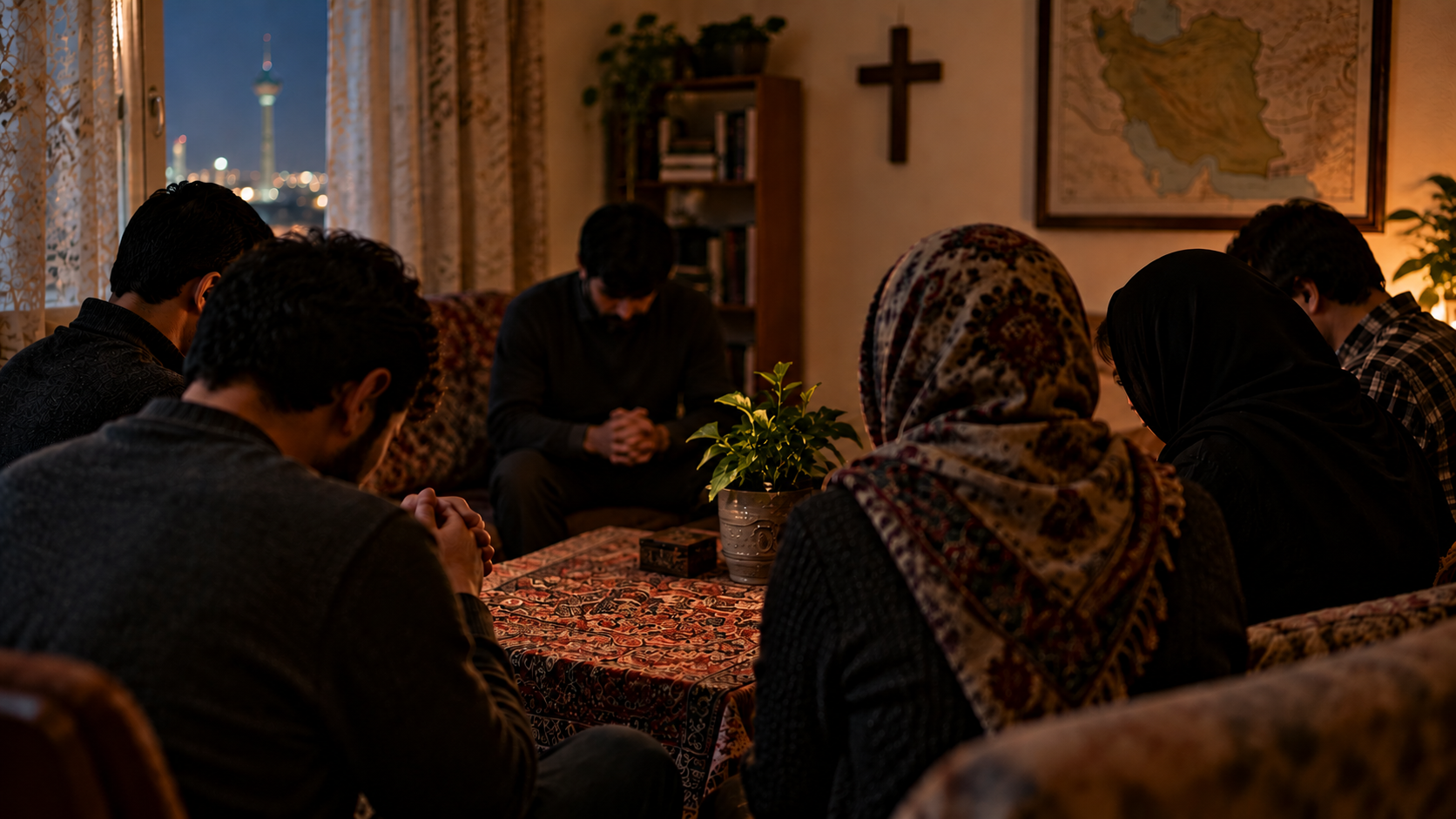
Sometimes it is simply a few believers gathered in a living room.
That simplicity is part of what makes the underground church difficult to measure—and important to understand.
Faith and Secrecy
People sometimes hear the phrase “underground church” and imagine something from a movie.
The reality can be much quieter.
It may mean carefully deciding whom to invite into a home. It can mean avoiding unnecessary identifying information. It can mean keeping gatherings small or dividing a growing group into smaller communities.
The 2026 UK report summarizes sources describing Iranian house churches as generally small and informal. It also reports that house churches may be connected through broader networks and that groups sometimes divide as they grow for security reasons.
Secrecy, therefore, is not necessarily about creating mystery.
For some communities, it is about protecting people.
What Risks Can Christian Converts Face?
The risks are not identical for every Christian in Iran.
That point should be emphasized.
According to the UK Home Office assessment, recognized historic Christian communities face restrictions and discrimination, but Christian converts who become known to authorities and seek to practice their faith openly may face considerably greater risks. The report documents arrests, detention, prosecution, prison sentences and other penalties involving converts and people engaged in evangelism.
The report also indicates that authorities have particularly focused on people involved in organizing house churches or actively spreading Christianity.
This is one reason responsible reporting about underground Christian communities must protect identities.
A photograph, name, city, meeting location, or seemingly harmless detail can reveal more than intended.
For IUHC, protecting people must come before telling a compelling story.
Why Is Baptism So Important?
For Christians throughout the world, baptism represents a public expression of faith and identification with Jesus Christ.
Within an underground Christian community, baptism can carry additional significance.
It may represent the moment when something that began privately becomes an outward declaration:
This is what I believe.
That is why reports of baptisms should never be understood merely as statistics.
Behind every number is an individual.
A person has a family.
A history.
Questions.
Fears.
Relationships.
And a story that existed long before the moment of baptism.
How Many Christian Converts Are There in Iran?
There is no precise, universally accepted number.
That is important to say clearly.
When religious communities operate partly in private, accurately counting them becomes extremely difficult. The UK Home Office’s 2026 report reviews estimates from multiple sources and notes substantial uncertainty surrounding the number of Christian converts and house-church participants in Iran. It cites estimates ranging into the hundreds of thousands and notes that some sources place the figure higher, while emphasizing the inherent difficulty of measuring secret communities.
For this reason, numbers published by individual ministries or underground networks should be clearly identified as their own internal reports or estimates, rather than presented as independently verified national statistics.
More Than Persecution
There is another important part of this story.
Iranian Christians should not be understood only through persecution.
They are people building friendships, raising families, studying, working, praying, asking questions, helping others, experiencing joy, and trying to understand what their faith means for everyday life.
If we speak only about arrests and danger, we risk reducing people to what has happened to them.
Faith is also about hope.
Community.
Transformation.
Belonging.
And the belief that even under difficult circumstances, a person’s life can have meaning.
Why These Stories Matter
Understanding Christian conversion in Iran requires more than statistics.
It requires listening to people.
It requires distinguishing between historic Christian communities and converts from Islam. It requires acknowledging that experiences differ from person to person. And it requires recognizing why some Christians choose to worship privately rather than publicly.
Most importantly, it requires remembering that behind phrases such as “Christian convert,” “house church,” and “underground church” are individual human beings.
Their stories should be told carefully.
Their identities should be protected when necessary.
And their lives should never become merely numbers on a page.
Behind every number is a person. Behind every person is a story.
RELATED ARTICLES
What Is an Underground House Church in Iran?
Learn why some Iranian Christians gather privately, what happens inside house churches, and why these communities often operate discreetly.
Why Are House Churches Growing in Iran?
Explore the factors associated with Iran’s underground Christian communities and why their size remains difficult to measure.
Source
UK Home Office, Country Policy and Information Note: Christians and Christian Converts, Iran, June 2026, updated August 26, 2026.