Faith Behind Closed Doors
In many parts of the world, going to church is an ordinary part of life. People drive to a church building, walk through the front doors, worship together, study the Bible, and return home. In Iran, the experience can be very different for Christians who have converted from Islam.
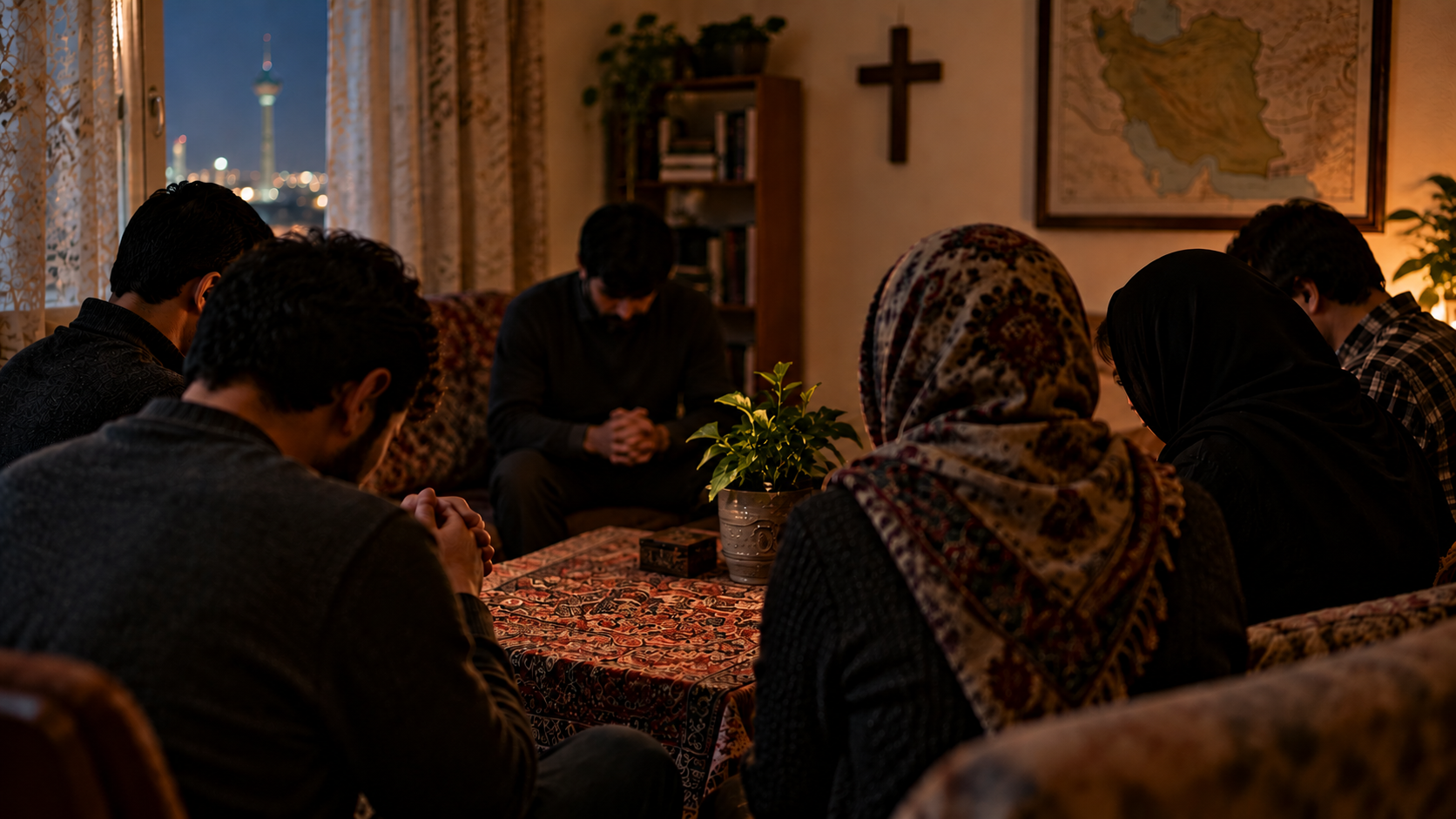
For many Iranian Christian converts, a church may not have a sign, sanctuary, stage, or public address. It may be a living room, apartment, or another private place where a small number of believers gather quietly.
These gatherings are commonly known as house churches.
Independent reporting describes Iranian house churches as generally small and informal communities where Christians gather to pray, worship, study the Bible, and share their faith. Some operate independently, while others are connected through networks.
For security reasons, this article does not identify underground believers, leaders, meeting locations, or other information that could place individuals at risk.
Why Do House Churches Exist in Iran?
Iran officially recognizes certain historic Christian communities, particularly Armenian and Assyrian Christians, but the situation is significantly different for people who convert from Islam to Christianity.
A June 2026 UK government country-information report states that recognized churches operate under restrictions and that Christian converts can face serious state pressure when they openly practice their faith. The report also documents arrests and detention of converts, particularly leaders and organizers, and notes that house-church raids continue to be reported.
This helps explain why some Iranian Christians worship privately.
The same report says converts may gather in homes because they cannot freely participate in recognized churches. House churches can therefore provide a place for prayer, Bible study, worship, Christian teaching, and community.
What Happens Inside a House Church?
A house church can look remarkably simple.
There may be no pulpit.
No stage.
No large worship team.
No church sign outside.
Instead, a small group may gather in a private home. They may pray together, read Scripture, discuss questions about Christianity, worship, encourage one another, and share meals.
Government country information citing several sources describes Iranian house churches as often consisting of small groups of friends or family. Some sources describe groups of roughly ten people, with larger groups sometimes dividing for security reasons. Structures vary considerably, so there is no single model that describes every Iranian house church.
That distinction matters.
There is no reliable public directory showing every underground church in Iran, and reliable nationwide numbers are difficult to establish precisely because these communities operate discreetly.
Why Is Secrecy Necessary?
For an underground Christian community, privacy can be more than a preference. It can be a matter of security.
Iranian authorities have monitored house-church activity, and reports describe raids, interrogation, arrests and prosecutions connected to Christian conversion, evangelism and house-church organization. Authorities have sometimes treated organized evangelical activity as a national-security matter.
This is why responsible reporting about underground Christians must be careful.
Photographs, names, neighborhoods, meeting schedules and seemingly insignificant details can potentially reveal more than intended.
At Iranian Underground House Churches (IUHC), we therefore believe that telling the story should never become more important than protecting the people inside the story.
There are stories we can share.
There are details we cannot.
How Large Is Christianity in Iran?
This is one of the most difficult questions to answer accurately.
There is no authoritative count of Christian converts in Iran. Estimates vary substantially because converts are not necessarily recorded as Christians in official records and underground communities, by definition, are difficult to count.
The 2026 UK country-information report reviews estimates ranging from hundreds of thousands to more than one million converts while emphasizing the uncertainty surrounding these figures. It also cites sources reporting continued growth in Christian communities and house churches.
For this reason, large numerical claims about Christianity in Iran should always be presented carefully.
When IUHC publishes figures derived from its own network, they should be understood as IUHC internal ministry reports or estimates, rather than independently verified national statistics.
That distinction strengthens credibility rather than weakening the story.
More Than Numbers
It is easy to talk about underground Christianity using numbers: numbers of churches, converts, baptisms, leaders, arrests or provinces.
But numbers alone cannot explain an underground church.
Behind every statistic is a person.
Someone may be opening a Bible for the first time.
Someone may be asking questions about Jesus that they have carried privately for years.
Someone may be preparing for baptism.
Someone may be teaching a small group.
Someone may simply be searching for a community where they can pray without pretending to be someone they are not.
The story of Iran’s house churches is therefore ultimately a story about people.
Leadership Without a Stage
House-church leadership can also look very different from conventional church leadership.
There may be no office, title, salary or public recognition.
A leader may simply be the person responsible for bringing believers together, teaching Scripture, providing pastoral support and helping a small community continue.
Country information reviewed by the UK government describes leaders as playing particularly important roles in bringing groups together and providing teaching and pastoral care. It also reports that Iranian authorities have often focused attention on organizers, leaders and people engaged in evangelism.
This creates a very different understanding of leadership.
Leadership is not necessarily visibility.
Sometimes leadership means accepting responsibility when visibility itself can create danger.
The Importance of Baptism
For Christians around the world, baptism represents a public expression of faith and identification with Jesus Christ.
Within an underground setting, however, even something as familiar as baptism may require careful preparation.
IUHC receives reports from its own ministry network about baptisms and discipleship activity. Because of the security circumstances surrounding these communities, we do not publish information that could identify participants or reveal sensitive meeting locations.
When we report baptism figures, the number is important—but the individual behind the number matters more.
Behind every number is a person, and behind every baptism is a story of faith.
Not Every Iranian Christian Has the Same Experience
It is also important not to describe all Christians in Iran as though their circumstances are identical.
Iran contains historic Armenian and Assyrian Christian communities as well as Christian converts from Muslim backgrounds and other Christian communities. Their legal recognition, worship practices and experiences with the government can differ substantially.
Similarly, not every house church operates in exactly the same way.
Some communities may consist of only a handful of people. Others may be connected to broader networks. Leadership structures, meeting patterns and practices vary.
Understanding these distinctions helps prevent an extraordinarily complex religious landscape from being reduced to a single narrative.
Why These Stories Matter
The underground church raises a question that extends far beyond Iran:
What does faith look like when practicing it carries a cost?
For some Iranian Christians, church is not primarily a building.
It is people.
It is someone opening a home.
It is several people gathering around Scripture.
It is prayer spoken quietly.
It is friendship.
It is discipleship.
It is choosing to continue believing even when public recognition is impossible.
That is what the phrase underground house church means to us.
Not an institution hidden beneath the ground.
A community of people practicing their faith away from public view.
And although the doors may be closed, the stories behind those doors deserve to be understood.
Pingback:Why Are House Churches Growing in Iran? – Becoming Joshua