A Quiet Movement Behind Closed Doors
By Joshua Ehm | September 19, 2026
When people imagine a church, they often picture a building, a sanctuary, rows of chairs, a pastor standing behind a pulpit, and a congregation gathering openly.
For many Christian converts in Iran, church can look very different.
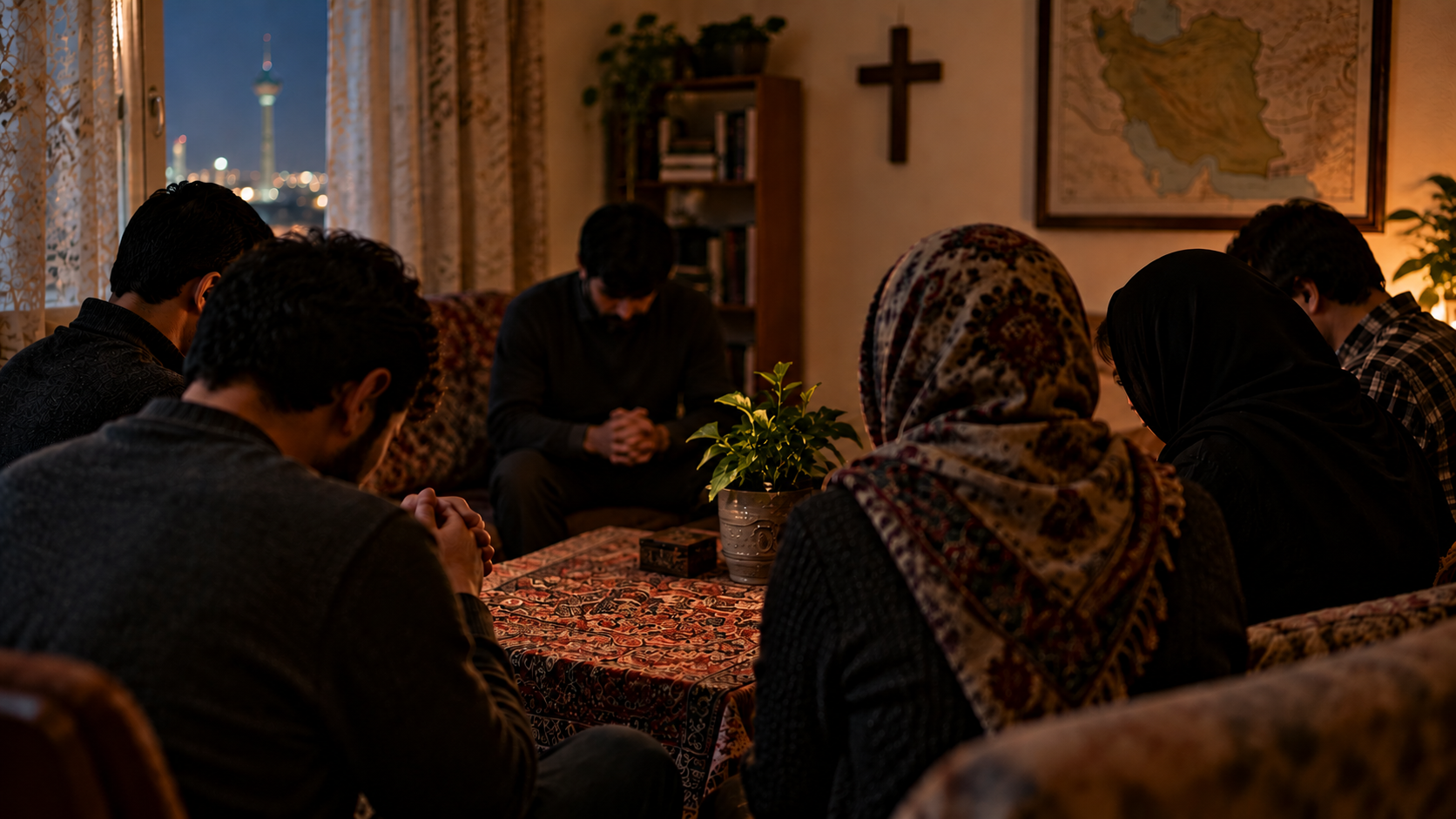
It may be a small gathering inside an apartment or private home. There may be no sign outside, no public announcement, and no large congregation. A few people may gather to pray, study the Bible, worship, talk about their faith, and support one another.
These gatherings are commonly called house churches.
As explained in our previous article, What Is an Underground House Church in Iran?, these communities exist partly because Christian converts from Islam do not have the same practical ability to worship openly as members of Iran’s historically recognized Christian communities.
But another question deserves attention:
Why do house churches continue to exist—and why are there reports that Christian-convert communities have grown despite the risks?
1. House Churches Provide Community
Faith is rarely experienced only as an individual matter.
People naturally seek community. They want to ask questions, pray with others, study together, and share their experiences.
For an Iranian who has converted to Christianity, finding that community can be difficult.
Iran recognizes certain historic Christian communities, particularly Armenian, Assyrian and Chaldean Christians. The situation is substantially different for Muslims who convert to Christianity. The June 2026 UK government country-information report says converts who openly practice their Christian faith can face serious state pressure.
As a result, private gatherings can become an important form of Christian community.
A living room can become a place of worship.
A small apartment can become a place of Bible study.
A gathering of a few trusted people can become a church.
2. House Churches Do Not Depend on Buildings
Traditional churches normally require physical infrastructure.
House churches do not.
They can function with relatively few resources because the central element is not a building—it is the people gathering together.
The UK government’s 2026 report, drawing on multiple country-information sources, describes Iranian house churches as generally small and informal. Participants may gather regularly or semi-regularly for prayer, worship and Bible study. Some groups are also connected through larger networks.
This structure makes house churches very different from conventional congregations.
There may be no large sanctuary to maintain.
There may be no public office.
There may be no sign identifying the meeting place.
Instead, Christianity can spread through relationships between individuals, families and small communities.
3. Relationships Are Central
One of the most important characteristics of a house church is its relational nature.
People often know one another personally.
They may eat together, pray together, study together and help one another through difficult circumstances.
This creates a form of Christian community that is difficult to measure simply by counting buildings or registered congregations.
It also helps explain why estimating the number of Iranian house churches or Christian converts is extremely difficult.
The UK government’s June 2026 report notes that estimates of Iran’s Christian-convert population vary substantially and that nobody knows the precise extent of growth because house churches operate secretly.
For that reason, claims about the exact number of converts or house churches should be treated as estimates rather than established national totals.
4. Pressure Has Not Eliminated House Churches
Operating privately does not mean operating without risk.
Iranian authorities have monitored house churches and conducted raids against some gatherings. Reports describe arrests and detention involving Christian converts, particularly leaders and organizers, although ordinary participants have also been affected.
The same report explains that authorities have treated organized house-church activity and evangelism as national-security concerns.
Yet house churches have continued to operate.
This creates an unusual situation: the very restrictions that make public Christian worship difficult for converts also contribute to the need for smaller and more private forms of Christian community.
5. Small Groups Can Multiply
A house church does not need hundreds of people to function.
In fact, small size can be part of its structure.
Country information cited by the UK government describes some Iranian house churches as groups of roughly ten people or fewer, with larger groups sometimes dividing into smaller gatherings for security reasons. Multiple house churches can also be connected through networks.
That means growth does not necessarily produce a larger congregation in one location.
It can produce another small gathering.
One group can become two.
New leaders can emerge.
Relationships can connect communities across different locations.
This decentralized structure helps explain how a Christian network can expand without constructing conventional church buildings.
6. Persian-Language Christianity Matters
Language is another important part of the story.
Iran’s recognized historic Christian communities have greater space to practice their religion, although restrictions remain. Government reporting notes that recognized church services face restrictions concerning Persian-language worship and participation by converts.
For Persian-speaking converts, house churches can therefore provide something particularly significant:
Christian worship and teaching in the language they use every day.
People can discuss questions about Christianity in Persian, study biblical teachings together, and communicate their experiences in their own cultural and linguistic context.
That can make a small private gathering deeply meaningful.
7. Growth Is Difficult to Measure
There are many dramatic claims online about Christianity becoming one of Iran’s fastest-growing religious movements.
Those claims require careful treatment.
Because underground communities intentionally avoid public registration and often protect the identities of participants, there is no reliable census of Iranian house-church membership.
Various organizations have produced estimates, but the numbers differ substantially.
The most responsible conclusion is therefore not to claim that anyone knows the exact number.
What can be documented is that Christian-convert house churches exist across Iran, that reports describe continuing participation in them, and that authorities continue to monitor and act against some of these communities.
More Than Numbers
It is tempting to describe underground Christianity entirely through statistics.
But numbers reveal only part of the story.
Behind every estimate is an individual.
Someone asking questions.
Someone encountering Christianity for the first time.
Someone opening a Bible.
Someone entering a private home.
Someone praying with another believer.
Someone deciding what faith means when practicing it publicly may carry consequences.
Whatever the precise number of house churches or Christian converts in Iran, the continued existence of these communities demonstrates something important:
A church does not always begin with a building. Sometimes it begins with a few people gathering quietly in a room.
Source
UK Home Office, Country Policy and Information Note: Christians and Christian Converts, Iran, June 2026.